
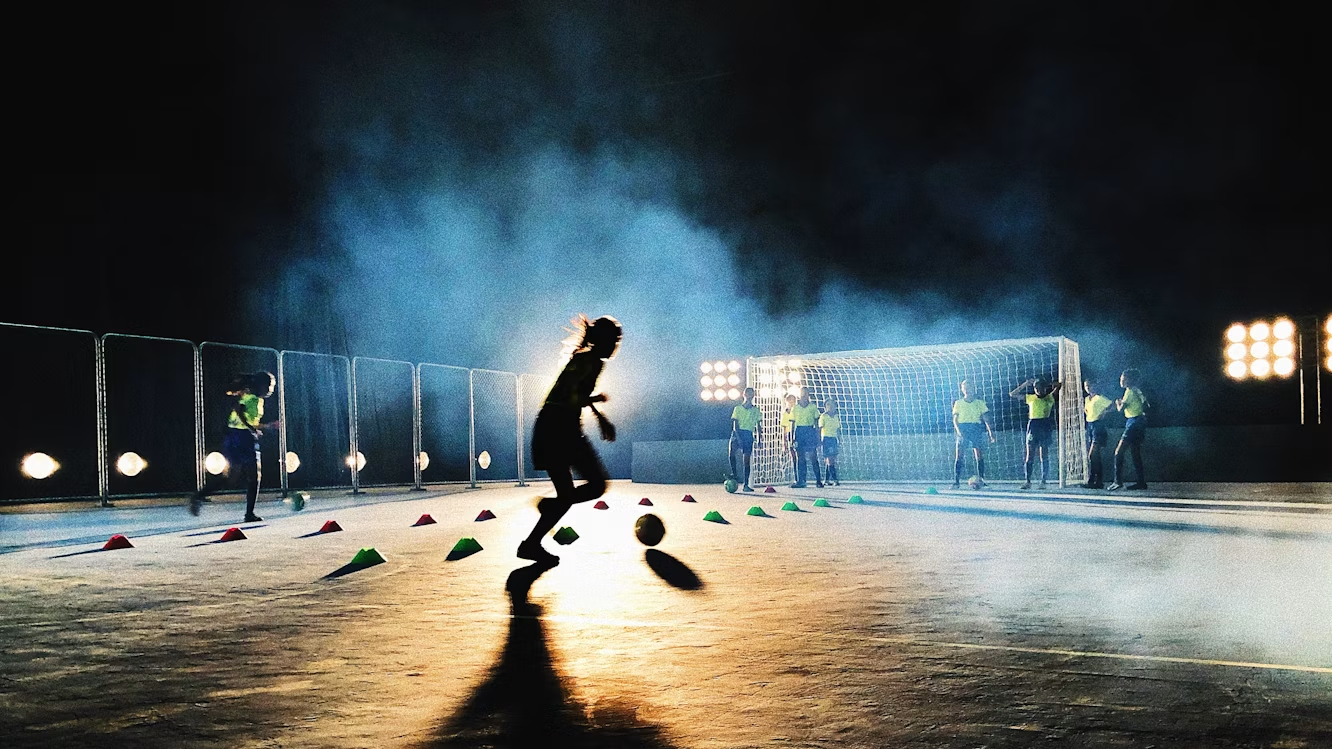
Soccer Fitness Testing helps coaches, trainers, and sports scientists measure an elite soccer player’s preparedness across the physical qualities the game demands: endurance, speed, agility, power, and body composition. Below is a breakdown of the most prominent Soccer Fitness Tests, organized by category, with the features and benefits of each. The importance and scale of soccer performance testing and training scales as a football player progresses through age, level, and his or her Individual Player Development Plan.

soccer Aerobic / Endurance Tests
Yo-Yo Intermittent Recovery Test
The Yo-Yo Intermittent Recovery Test is the gold standard for soccer-specific aerobic testing. Players run 20-meter shuttles at speeds dictated by an audio beep, with a short 10-second active recovery jog between each shuttle. As the test progresses, the pace increases until the player can no longer keep up with the beep, at which point the total distance covered becomes the score.
SOCCER FITNESS TEST FEATURES:
- Combines running speed with built-in active recovery periods
- Progressive, beep-paced protocol available in Level 1 (recreational to sub-elite) and Level 2 (elite/professional) versions
- Requires only cones, an audio file, and a flat 20-meter space
SOCCER FITNESS TESTING FEATURES:
- Mimics the stop-start, intermittent movement patterns unique to soccer far better than a straight-line run
- Strong predictor of match-running performance, including high-intensity distance covered during games
- Widely validated across professional leagues, making results easy to benchmark against elite standards
- Simple to administer with large squads simultaneously, saving valuable training time
- Tracks improvements in repeated high-intensity running capacity, a key indicator of match fitness and fatigue resistance
Because it was designed specifically with intermittent sports in mind, the Yo-Yo test has become the preferred endurance assessment at professional and academy levels worldwide, replacing more generic aerobic tests in most high-performance environments.
Cooper Test
The Cooper Test is a classic 12-minute maximal-effort running test originally developed for the U.S. military to estimate aerobic capacity (VO2 max) using a simple field-based protocol. The athlete runs continuously for 12 minutes, and the total distance covered is plugged into a standard formula to estimate cardiovascular fitness.
SOCCER FITNESS TEST FEATURES:
- Requires only a stopwatch, a measured track or course, and 12 minutes
- Produces a distance-based score that converts directly into an estimated VO2 max value
- Continuous, steady-state format rather than shuttle-based or interval-based
SOCCER FITNESS TESTING FEATURES:
- Extremely easy and low-cost to administer, making it accessible for grassroots clubs, schools, and amateur teams without specialized equipment
- Provides a quick baseline snapshot of general cardiovascular fitness at the start of preseason
- Useful for tracking broad aerobic conditioning trends over time in players and teams
- Requires no technology, apps, or audio files, unlike beep-based protocols
- Well-established normative data exists across age groups and fitness levels for easy comparison
While it remains a fast and practical way to estimate general aerobic capacity, the Cooper Test doesn’t replicate soccer’s constant accelerations, decelerations, and direction changes, so many clubs now use it mainly as an entry-level or supplementary aerobic check rather than a primary soccer-specific fitness measure.
Beep Test (20m Multi-Stage Fitness Test)
The Beep Test, also known as the 20m Multi-Stage Fitness Test, is a progressive shuttle run where players run between two lines 20 meters apart, timed to an increasingly fast audio beep, continuing until they can no longer keep pace.
SOCCER FITNESS TEST FEATURES:
- Stage-based structure with speed increasing roughly every minute
- No active recovery jog built in, unlike the Yo-Yo test
- Score recorded as the level and shuttle number reached at exhaustion
SOCCER FITNESS TESTING FEATURES:
- Simple, low-cost, and easy to administer to large groups at once
- Long track record of use in schools, grassroots clubs, and general fitness testing
- Provides a reliable estimate of aerobic capacity and VO2 max
- Familiar format that many players and coaches already understand
- Useful for baseline fitness screening before progressing to more sport-specific protocols
The Beep Test remains a solid entry point for assessing general aerobic fitness, particularly at youth and recreational levels, before athletes progress to the more soccer-specific Yo-Yo protocol.
VO2 Max Testing (Lab-Based)
VO2 max testing measures the maximum rate of oxygen an athlete can utilize during intense exercise, typically performed on a treadmill or bike ergometer in a controlled lab setting while wearing a mask connected to gas-analysis equipment.
SOCCER FITNESS TEST FEATURES:
- Direct, highly accurate measurement of aerobic capacity using respiratory gas analysis
- Conducted under controlled lab conditions with incremental exercise intensity
- Often paired with lactate threshold testing for a complete physiological profile
SOCCER FITNESS TESTING FEATURES:
- Provides the most scientifically precise measure of cardiovascular fitness available
- Allows for individualized training zone prescriptions based on exact physiological data
- Useful for monitoring long-term aerobic development across a season or career
- Helps identify underlying fitness limiters that field tests can’t detect
- Valuable for return-to-play protocols after injury, ensuring conditioning benchmarks are met safely
Though more expensive and time-intensive than field tests, lab-based VO2 max testing offers professional clubs and sports scientists the gold-standard data needed for precision training and performance monitoring.
Stanford Soccer Fitness Test
The Stanford Soccer Fitness Test is a demanding, multi-stage protocol popularized by Stanford’s collegiate soccer program and widely adopted by high school and club teams as a preseason conditioning benchmark. Performed on a 400m track with a soccer field in the middle, it alternates distance runs with repeated shuttle sprints, blending aerobic endurance with anaerobic recovery capacity in a single continuous session.
SOCCER FITNESS TEST FEATURES:
- Structured sequence combining distance runs (1/2 mile and 1/4 mile efforts) with 6-18-60 yard shuttle sprints
- Standardized time targets for each stage, such as a half-mile in 2:30 or better and a shuttle sprint in 32 seconds or better
- Fixed, short rest periods (typically 1 minute or less) between stages, mimicking match-like recovery windows
- Requires only running shoes, a stopwatch, and access to a track with a soccer field in the middle
- Concludes with a final half-mile effort to assess fitness under accumulated fatigue
SOCCER FITNESS TESTING FEATURES:
- Tests aerobic endurance and repeated-sprint anaerobic capacity in one combined assessment, rather than requiring separate tests
- Closely mirrors the physical demands of a full match, where players must sustain output across 90 minutes while repeatedly sprinting and recovering
- Provides clear, well-known pass/fail benchmarks that college and high school coaches use to gauge preseason readiness
- Highly time-efficient for squads, since it evaluates multiple fitness qualities in a single session rather than scheduling separate endurance and sprint tests
- Builds mental toughness and race-day readiness, as its difficulty and structure closely simulate the fatigue and pressure of real competitive play
Because it demands sustained pace across both distance running and repeated shuttle sprints, the Stanford Soccer Fitness Test has become a recognized rite of passage for college-bound and competitive high school players, often cited alongside the Cooper Test and Beep Test as a preseason fitness standard.
soccer Speed Tests
Sprint Tests (10m, 20m, 30m)
Sprint tests measure how quickly a player can cover short, fixed distances, typically timed using electronic timing gates for accuracy. The 10m split captures acceleration, while 20m and 30m splits capture a blend of acceleration and approaching top-end speed.
SOCCER FITNESS TEST FEATURES:
- Straight-line sprints over standardized distances (10m, 20m, 30m)
- Usually timed with laser or photocell timing gates for millisecond accuracy
- Can be broken into split times to analyze acceleration phases separately from top speed
SOCCER FITNESS TESTING FEATURES:
- Directly measures explosive acceleration, critical for winning first-to-the-ball situations in matches
- Highly reliable and repeatable, making it easy to track progress over a season
- Quick to administer, requiring only a short sprint lane and timing gates
- Provides actionable data for individualized speed and power training programs
- Correlates strongly with key match actions like breaking away from defenders or closing down attackers
Sprint testing gives coaches concrete, objective data on a player’s raw speed, one of the most valuable and sought-after physical attributes in modern soccer.
Flying Sprints
A flying sprint measures maximum velocity by timing an athlete over a set distance after they’ve already built up speed with a running start, isolating top-end speed from acceleration ability.
SOCCER FITNESS TEST FEATURES:
- Athlete accelerates over a run-up zone before entering the timed section
- Timing gates capture only the maximum-velocity segment of the sprint
- Distinguishes pure top-speed capability from acceleration mechanics
SOCCER FITNESS TESTING FEATURES:
- Isolates maximum sprint speed, a distinct physical quality from acceleration
- Helps identify whether a player’s speed limitations stem from acceleration or top-end mechanics
- Informs targeted sprint mechanics and speed development training
- Useful for wide players and forwards whose game relies heavily on straight-line pace
- Provides a clear, trackable metric for monitoring speed development over time
By separating acceleration from top speed, flying sprint tests give coaches a clearer picture of exactly where a player’s speed profile needs development.
SOCCER Agility Tests
505 Agility Test
The 505 Agility Test measures a player’s ability to decelerate and change direction quickly. The athlete sprints 15 meters, hits a timing gate, decelerates, pivots 180 degrees around a marker, and sprints back through the gate, with only the final 5 meters before and after the turn timed.
SOCCER FITNESS TEST FEATURES:
- Focused specifically on the deceleration-and-turn phase of movement
- Can be performed off either leg to assess left-right asymmetries
- Requires minimal equipment: cones and timing gates
SOCCER FITNESS TESTING FEATURES:
- Highlights direction-change ability, a critical but often overlooked component of match agility
- Identifies imbalances between dominant and non-dominant legs, useful for injury prevention
- Quick to set up and test, ideal for regular monitoring throughout a season
- Provides insight into deceleration mechanics, closely linked to hamstring and knee injury risk
- Complements straight-line speed data with a true change-of-direction metric
Because soccer rarely involves purely straight-line running, the 505 test gives a more realistic picture of the agility demands players face during actual matches.
T-Test
The T-Test is a multidirectional agility assessment combining forward sprinting, lateral shuffling, and backward running around cones arranged in a T-shape, capturing a broader range of movement patterns than single-direction tests.
SOCCER FITNESS TEST FEATURES:
- Course layout requires forward, lateral, and backward movement in one continuous test
- Total time to complete the course is the primary outcome measure
- Requires four cones and a stopwatch or timing gates
SOCCER FITNESS TESTING FEATURES:
- Assesses a wider variety of movement skills in a single test compared to linear agility drills
- Closely mirrors the varied directional demands players encounter during matches
- Simple and inexpensive to set up, suitable for teams of any level
- Useful for tracking overall agility development across a preseason or training block
- Easy to standardize and repeat for consistent season-long monitoring
The T-Test’s blend of movement directions makes it a practical, well-rounded agility screening tool for squads at any level of competition.
Illinois Agility Test
The Illinois Agility Test is a longer, more complex course that combines straight sprinting with weaving through a series of cones, testing an athlete’s ability to sustain agility and coordination over an extended distance.
SOCCER FITNESS FEATURES:
- Longer course (10 meters by 5 meters) with multiple directional changes and weaving sections
- Combines sprinting, cutting, and weaving in a single continuous run
- Timed from start to finish, providing one overall agility score
SOCCER FITNESS TESTING FEATURES:
- Tests sustained agility and coordination rather than a single quick change of direction
- Provides a comprehensive measure of overall movement efficiency under fatigue
- Long history of use across multiple sports, giving strong normative comparison data
- Useful for assessing footwork and body control at speed
- Good indicator of an athlete’s ability to maintain technique during extended agility demands
The Illinois Agility Test’s extended format makes it particularly useful for evaluating how well a player sustains sharp, coordinated movement over a longer passage of play.
SOCCER Power / Strength Tests
Countermovement Jump (CMJ)
The Countermovement Jump measures explosive lower-body power by having an athlete perform a rapid downward movement immediately followed by a maximal vertical jump, typically measured on a force plate or contact jump mat.
SOCCER FITNESS TEST FEATURES:
- Captures jump height along with advanced metrics like power output, force, and rate of force development
- Usually performed on a force plate or jump mat for precise data
- Can be repeated regularly with minimal fatigue cost to the athlete
SOCCER FITNESS TESTING FEATURES:
- Provides a reliable, non-fatiguing snapshot of an athlete’s readiness and neuromuscular fatigue on any given day
- Directly relates to explosive actions in soccer like jumping for headers and explosive sprinting
- Sensitive to changes in training load, making it a popular daily or weekly monitoring tool
- Non-invasive and quick, taking only minutes to complete
- Helps identify strength and power asymmetries between legs when tested unilaterally
Because it’s quick, safe, and highly sensitive to fatigue, the CMJ has become one of the most widely used daily monitoring tools in professional soccer performance departments.
Broad Jump (Standing Long Jump)
The broad jump is a simple field-based power test where an athlete jumps forward as far as possible from a standing start, with the distance measured from the takeoff line to the nearest point of contact on landing.
SOCCER FITNESS TEST FEATURES:
- Requires no equipment beyond a tape measure and marked starting line
- Measures horizontal power output rather than vertical power
- Quick to administer to large groups with minimal setup time
SOCCER FITNESS TESTING FEATURES:
- Provides an accessible, low-cost alternative to force-plate jump testing
- Reflects horizontal power production, relevant to sprint starts and explosive acceleration
- Easy to repeat regularly for tracking power development over a season
- Requires no technical equipment, making it ideal for grassroots and school-level testing
- Correlates well with sprint acceleration performance, a key attribute in soccer
The broad jump’s simplicity makes it one of the most practical power tests available, especially for programs without access to force plates or specialized jump equipment.
Repeated Sprint Ability (RSA) Test
The Repeated Sprint Ability test involves performing multiple short, maximal-effort sprints (typically 6 sprints of 20-40 meters) separated by brief recovery periods, measuring how well a player maintains sprint speed as fatigue accumulates.
SOCCER FITNESS TEST FEATURES:
- Multiple short sprints with short, standardized recovery intervals between efforts
- Measures both best sprint time and percentage drop-off across repeated efforts
- Timing gates typically used to capture precise splits for each sprint
SOCCER FITNESS TESTING FEATURES:
- Closely replicates the repeated high-intensity efforts required throughout a 90-minute match
- Identifies fatigue resistance, a critical quality for late-game performance
- Highlights whether conditioning or speed training should be prioritized based on drop-off patterns
- Provides a match-realistic assessment beyond a single maximal sprint effort
- Useful for tracking improvements in anaerobic recovery capacity over a training block
RSA testing captures a dimension of fitness that single-sprint tests miss entirely: the ability to reproduce top speed again and again under fatigue, exactly as required in match play.
Body Composition
Skinfold Measurements and Bioelectrical Impedance Analysis (BIA)
Body composition testing estimates a player’s body fat percentage and lean mass using either skinfold calipers, which measure subcutaneous fat at multiple sites on the body, or bioelectrical impedance analysis, which sends a low-level electrical current through the body to estimate fat and muscle mass.
SOCCER FITNESS TEST FEATURES:
- Skinfold testing uses calipers at standardized anatomical sites (e.g., triceps, abdomen, thigh)
- BIA uses handheld or platform devices that pass a painless electrical current through the body
- Both methods are typically combined with height and weight for a full body composition profile
SOCCER FITNESS TESTING FEATURES:
- Provides an objective measure of body fat percentage and lean muscle mass
- Helps identify optimal playing weight and body composition trends over a season
- Quick and non-invasive, usually taking only a few minutes per athlete
- Useful for monitoring the effectiveness of nutrition and strength programs
- Portable and repeatable, making it practical for regular squad-wide screening
Tracking body composition alongside performance testing gives coaches and sports scientists a fuller picture of how physical conditioning and nutrition are influencing a player’s readiness and injury risk over time.
Summary
From the intermittent shuttle demands of the Yo-Yo Test to the simplicity of the Cooper Test, and from explosive countermovement jumps to repeated sprint ability protocols, soccer fitness testing covers every physical quality the modern game requires. Choosing the right combination of tests depends on a team’s level, resources, and specific performance goals, but together these assessments give coaches a complete, data-driven picture of player readiness.